Agentic Leadership: Embedding Sound Strategy Principles in the AI-Powered Organization

In the emerging era of agentic AI, organizational success depends on a unified foundation that extends beyond human teams. The “one pizza team” - a compact unit of two to three human subject-matter experts supported by autonomous AI agents, or “clankers” - represents the lean, high-velocity model that will define durable businesses. Agentic leadership is the discipline of aligning every actor, whether human or artificial, around a single vision, mission, core values, and leadership principles. This alignment ensures that AI systems contribute effectively to strategic execution. With the commoditization of intelligence, the ability to cascade a consistent shared consciousness representing unified strategy, objectives, priorities, and expectations can be the difference between exponential value creation vs. slop-induced paralysis.
O21 Solutions’ Sound Strategy framework supplies the architecture for this alignment. Built on Bitcoin’s properties of proof-of-work meritocracy, savings culture, long-term orientation, and verification-first logic, the framework’s twelve principles operate as core operating standards. When embedded at the organizational foundation - through human processes, AI system prompts, evaluation criteria, and capital-allocation decisions - the principles transform the one-pizza team into a coherent strategic engine.
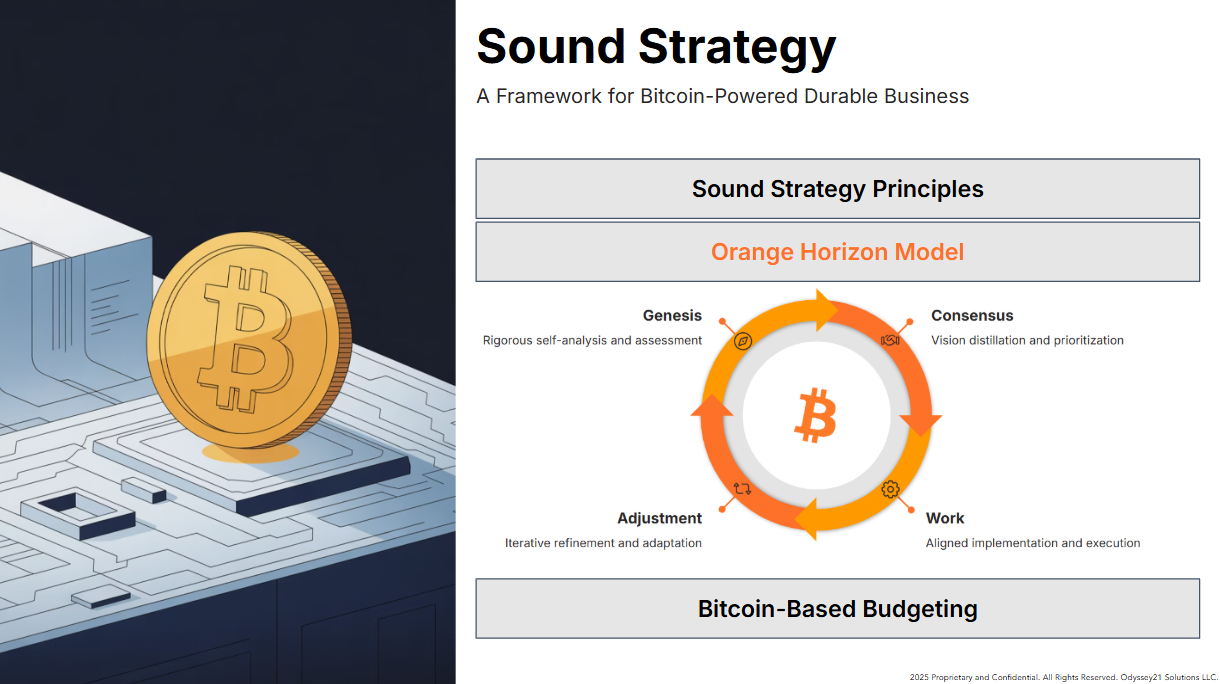
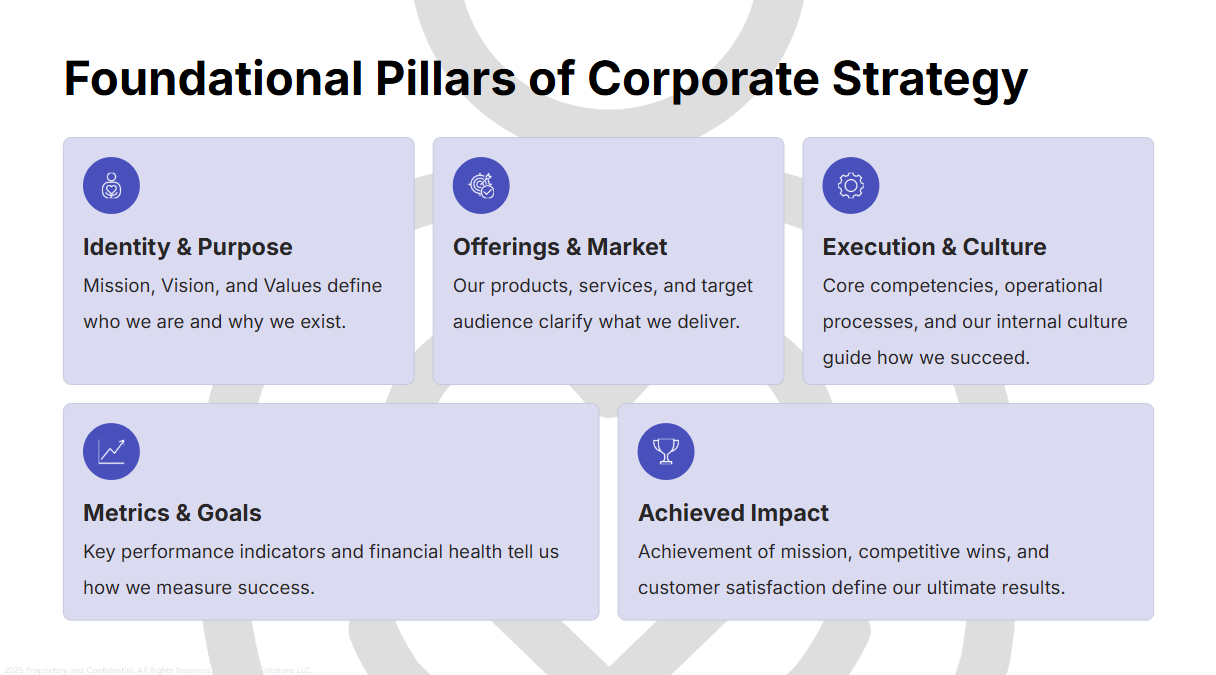
The principles function as operational standards that translate the classic elements of corporate strategy (culture, vision, mission, tactics, capital allocation) into practice.
Value for Value: Exchanges deliver mutual, verifiable benefits. AI agents and humans alike produce outputs that create genuine benefit.
Excellence: Superior quality and integrity set the performance baseline. For automated work, agents operate with clear requirements, complete definitions of done, and built-in quality controls to ensure outputs align with high-quality expectations. Agents apply first-principles reasoning and error-correction routines; human oversight maintains the standard.
One Chair: Lean operations are maintained through Bitcoin’s hurdle rate. Agents consider cost implications when selecting the best course of action, recognizing that an effective but expensive solution may not serve the organization’s interests. Every commitment of resources - human effort or compute - is assessed against the opportunity cost of additional sats.
Verify, Don’t Trust: Data, outputs, and assumptions undergo independent verification. Agents incorporate robust access controls based on the principle of least privilege, with verification of outputs built into workflows; leaders apply consistent scrutiny.
Accountability: Ownership remains non-delegable. Each priority owner, human or agent, manages the company’s responsibilities with the same level of care and produces expected outcomes.
Art of the Possible: Grounded optimism supports innovation. Agents model transformative scenarios within defined boundaries; humans challenge norms while preserving fiscal discipline.
Just Do Things: Action receives priority over prolonged analysis. Agentic workflows incorporate rapid iteration, taking proactive action within predefined guardrails; human processes reward measured momentum.
Stay Humble and Stack Sats: Low time-preference guides decision-making. Agents need to deliver real results. Slop won't be tolerated.
Transparency: Communication remains open and factual. Agent decisions and actions are logged and accessible, communicated accurately; human updates follow the same protocol.
Embrace Volatility: Uncertainty is treated as a source of opportunity. Both humans and agents are positioned to capitalize on market, regulatory, or technological shifts.
Decentralize Authority: Scoped autonomy accelerates adaptation. Agents operate within clear parameters; humans provide oversight without unnecessary intervention.
Learn Continuously: Ongoing education and refinement are standard practice. Agents receive updated knowledge bases; humans maintain structured learning routines.
These principles integrate at three levels:
Human layer: Onboarding, performance frameworks, and capital-allocation processes reference the principles directly.
AI layer: Prompts, tool-use policies, and evaluation functions incorporate the principles as fixed constraints and foundational context.
Governance layer: Serves as the shared operating rhythm - cascading the what, why, and how to every actor within the organization, human or otherwise.
This structure converts corporate strategy from a static document into an active, agent-augmented process. Short-termism, bloat, and misaligned incentives diminish because the network of one-pizza teams operates under sound principles. The outcome is durable competitive advantage through disciplined execution and resource allocation.
Embedding the twelve Sound Strategy principles from the outset equips the organization with a compact, aligned engine capable of operating at the pace of Bitcoin while maintaining the integrity required for long-term durability.
Ultimately, organizational impact depends on the ability to establish deep shared context across the entire workforce - human and agentic alike. When every participant holds a clear understanding of what the organization does and why it exists, operates under explicit expectations of how work is conducted, and prioritizes meaningful outcomes over raw output, real and lasting value is produced. Agentic leadership embeds these elements into the organizational foundation, forging a force-multiplying engine that amplifies execution while preserving strategic coherence.